


On October 4th 2025, Georgians will head to the polls for local elections in what mainstream opposition parties say is an unfair electoral environment. Meanwhile a leading Georgian election monitoring organization has stated the environment lacks the conditions for free, fair, and competitive elections. These elections highlight a Georgian Dream government taking deliberate steps to discredit and stigmatize civil society, choke off their avenues for financial support, and isolate civil society from the international community; all while taking incredible steps to silence dissenting voices and move towards complete state capture.
In the last 16 months, the Georgian Dream government has followed the legislative playbook written by the Russian government, and adopted by regimes like those in Azerbaijani and Belarus, to discredit, undermine, attack, de-fund, and isolate independent civil society.
The current human rights crisis and attack on civil society began in May 2024 with the passage of the law on Transparency of Foreign Influence – what is often referred to as the Russian-style foreign agents law. At the time of its passage Georgian and international NGOs warned that it would be used to conduct investigations of independent media and NGOs in an attempt to discredit, pressure and eventually silence independent voices. The warning came because this is exactly what has happened in Russia following the adoption of its first foreign agents law in 2012 and has continued to this day.
Next, in April, the Georgian Dream government adopted the Foreign Agents Registration Act. The law is a copy of the US Foreign Agents Registration Act (FARA); however – and this is the crucial piece – the intended use mirrors Russia’s implementation of its restrictive “foreign agent” legislation. It introduces criminal liability for human rights defenders and their organizations who fail to register under the label of “foreign agent” for receiving any foreign funding for their legitimate human rights work. At the time of its introduction and passage five months ago, civil society warned that the law would be used to silence dissenting voices and stop the work of independent civil society. Today, the state has opened formal investigations to some of the most vocal civil society organizations, mirroring how states like Azerbaijan use the tools of the state to silence watchdogs and human rights defenders.
In the same month, in April 2025, the Georgian Dream government also amended the law on grants. The law requires foreign donors to obtain official governmental approval prior to distributing grants to local organizations, in effect limiting or outright hindering the autonomy of civil society. Receiving a grant without official approval results in a fine equal to twice the amount of the grant. The Georgian Dream government further amended the law in June to expand the requirement for official consent to include “technical assistance” and “knowledge sharing.” In a country where the primary source of funding for CSOs are foreign donors, this effectively chokes off civil society from critical operating funds. Many international NGOs point to the Azerbaijani government’s 2009 law which placed similar requirements as an important step in the Azerbaijani authorities ultimate dismantling of independent civil society inside of Azerbaijan.
Of course, these steps did not happen in a vacuum. They took place in the context of the Georgian society taking to the streets and, ultimately, the largest public protests in the history of independent Georgia; protests which call into question the legitimacy of the Georgian Dream government, and pushback on the Georgian Dream government’s decision to end EU accession talks. The Georgian Dream government’s legislative attacks on civil society take place at the same time that the government is employing violence and other draconian steps to try to quell protests while attempting to paint the protests, and protesters, as simply the result of foreign interference in domestic affairs.
Throughout these protests, independent civil society has taken on many of the roles it normally plays in a liberal democracy. It has provided legal aid and other support to protesters facing attacks, acted as a watchdog against government overreach, monitored and reported on human rights violations, and pressured authorities to uphold their legal obligations to protect human rights and fundamental freedoms. In these actions, the Georgian Dream government sees a threat to its power and against this threat, it has moved to employ legislative means – among others – to shut down independent civil society.
As the Georgian Dream government took these extraordinary steps, Georgian civil society and their partners sought to raise the alarm: predicting the weaponization of these laws, and others, to target them.
On March 17th 2025, the law enforcement froze bank accounts of five civil society organizations, including Human Rights House Tbilisi, who were standing in solidarity with the protesters and collecting money from Georgian citizens and Georgian businesses to cover the fines of unjustly fined demonstrators. In August – as civil society warned – the Georgian Dream government launched its first investigations into independent civil society under the new FARA law. Also in August, the government froze the accounts of seven additional civil society organizations as part of an investigation into “sabotage, attempted sabotage under aggravated circumstances, assisting a foreign organization or an organization under foreign influence in hostile activities, and financing actions against Georgia’s constitutional order and national security.” These articles carry penalties ranging from seven years to life in prison. The use of sabotage laws to target civil society organizations is a strategy reminiscent of similar ones employed by the Belarusian authorities, charging human rights defenders and organizations under laws to address incitement to violence.
As we see in Belarus and Russia, the totality of these new or expanded laws and subsequent investigations has a chilling effect on civil society and anyone brave enough to express dissent. Even those organizations who have not been specifically targeted yet are forced to prepare for the impact of the legislation aimed against civil society. For those who are targeted, it means that their work is frozen or ended. Staff are laid off, though many continue their work as volunteers. Leaders are using time and resources to fight legal battles for their legitimate human rights work. And their organizations’ beneficiaries – the Georgian people – pay the price.
Although the rate of how quickly the developments have happened in Georgia is surprising, we have seen the exact same playbook implemented in a number of other countries. There is no doubt that the Georgian Dream government are using the tools of the state to attack independent civil society, discredit its role and work, choke its funding, isolate it from the international community, and ultimately make its work illegal and impossible inside of Georgia. The steps being taken are nearly mirror images of those we all saw – and condemned – in Russia, Azerbaijan, and Belarus in the 2000s and 2010s, failed to adequately respond to, and whose impact we continue to see today. The international community has the opportunity to learn from those mistakes and apply those lessons in its response to the Georgian Dream government.
The Georgian Dream government is still sensitive to international pressure. It is still acting as though international legitimacy is important. The Georgian Dream government is still responding to international monitoring and reporting. But this window will close – as it did in Belarus and Russia – and the international community will lose some of its leverage. This is the moment to apply maximal pressure.
In this regard, it is vital that the international community coordinate effectively across the multilateral system to ensure maximum pressure, accountability, and coherence of strategy in responding to the Georgian Dream government’s actions. International donors must support Georgian civil society and not be deterred from engagement. Partners should signal clearly that no law stigmatizing civil society on the basis of funding sources can be compatible with international human rights standards and norms. At the same time, they must urgently overcome administrative blockages to provide additional funding to Georgian civil society and human rights organizations to help them withstand the immediate impact of the asset freezes and continue their important work.
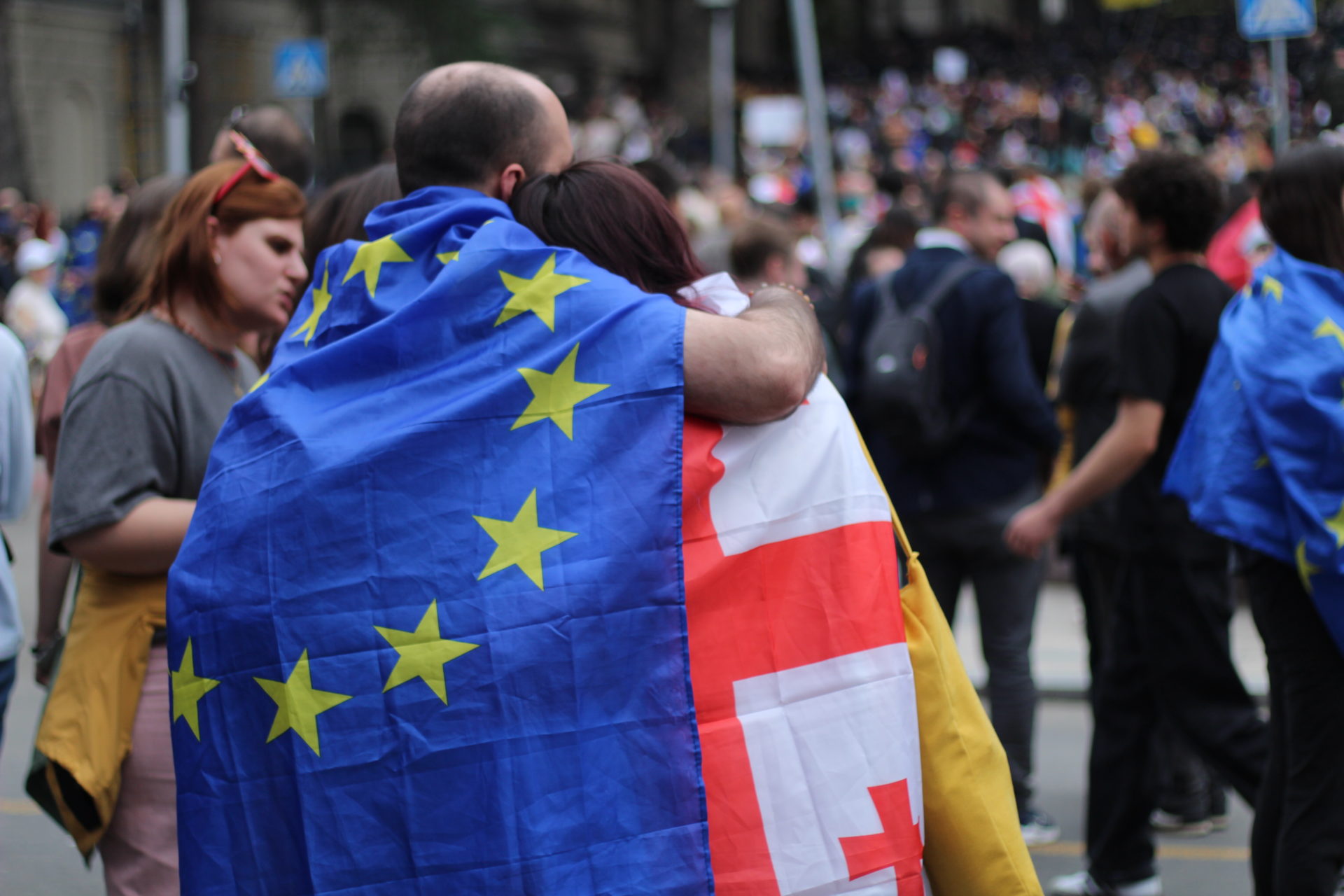
Top Photo: Peaceful protests in Tbilisi in May 2024 via Tamta Chkhaidze / Human Rights House Tbilisi

