


This interview, produced by Human Rights House Foundation, was originally published by New Eastern Europe on 12 September 2025.
Note: To protect their safety, the identities of the human rights defenders interviewed have been withheld. Their responses have been edited for clarity and coherence.
What is the situation for human rights in Azerbaijan today, and how has it changed in recent years?
Human Rights Defender 1 (HRD1) Since the summer of 2023, we’ve seen a massive, non-stop crackdown on the entire Azerbaijan civil society.
What we’re witnessing is not just shrinking space—it’s the closing of civil society in Azerbaijan, leaving no one inside the country in an organised form to safely operate and survive.
At the earliest times, in 2022, it started with the arrest of public and political figures, then continued with mass arrests of trade union members and spread in waves to different elements of society, including the notable detentions of Abzas Media in November 2023. Then came the arrests of individual journalists, followed by more NGOs and human rights defenders. Even academics, economists, peace activists and those living and operating outside of Azerbaijan have faced fabricated criminal charges resulting in long imprisonments.
Human Rights Defender 2 (HRD 2) It’s not limited to civil society. Political parties are under pressure, too. Before that, it was non-conformist religious groups—particularly Shi’a Muslims—who were arrested and even tortured. Now, if ordinary people say something that’s not in line with the government policy on Instagram or TikTok, they will be called, interrogated… intimidated somehow.
Compared to the crackdown in 2013-2015, the first difference is the scale. It’s massive. Back then, the number of arrests was a lot less; and they mostly went after the heads of NGOs. Now they can arrest, intimidate or even torture anyone. There are nearly 375 political prisoners in the country [this number is accurate as of 9 June 2025].
What we observe now is that the government wants to have no dissenting voices. They have started to widely apply travel bans, not only to “suspects”, but also to their family members. Some have had their bank accounts frozen.
There’s also a quiet form of intimidation happening that we think is being overlooked because it perhaps looks “less harsh”. People are increasingly called for informal meetings in public places. These café interrogations by state security agencies are on the rise, and many are too scared to speak about it. These so-called conversations often happen before arrests.
[Azerbaijan’s authorities] no longer imitate any democratic norms. Now they openly attack them.
The narrative from government officials over the last few years has shifted. “Human rights” and “democracy” are gone from the conversation. Now they speak of “a global geopolitical shift”, a “new reality”, and a “pragmatic” [economic] relationship with the West. This is an open declaration of alignment with authoritarian countries. When it comes to human rights and democracy, they say it is an internal issue of Azerbaijan, and nobody has the right to interfere.
HRD 1 There’s a strong smear campaign against civil society, this time it even targets the GONGOs [government-organised non-governmental organisations]. The current narrative is that civil society is not needed anymore. Even more neutral topics like gender equality, which the government used for decades via GONGOs and cooperation with international organisations in imitation of democratic values, are no longer tolerated.
Human Rights Defender 3 (HRD 3) Another key difference from the previous crackdown is that there was a strong global support from the governments and international institutions in the defence of political prisoners and in support of civil society. There were campaigns all over the world, in America, in Europe, a strong campaign during Eurovision too.
Solidarity was everything in 2014. It’s how we survived. Independent media and NGOs ran campaigns. International organisations supported us, and there were many resolutions. Now you can feel that it has decreased dramatically, because the civil society is destroyed in the country. There are no people left in the country, there are dissidents, you can call them, you can count them with your fingers. And outside the country, this support has significantly weakened.
Now, states seen as democratic, [are willing to cooperate with] Aliyev. The Secretary General, the Council of Europe, the official list of leaders of the European Union, and so on. The situation is that civil society is practically left without protection from the outside.
Human Rights Defender 4 (HRD 4) The government of Azerbaijan has been dismantling civil society for decades. Step by step, the authorities have changed the legislation—weaponising it—while dismantling the judiciary over the past 20 to 25 years, leaving it completely non-independent. There is no civil society left since 2014, which means there are fewer people to monitor what’s happening, to report on it. And fewer people are interested—because it’s simply not safe.
Even donor organisations that supported civil society or major organisations are very reluctant to renew their projects, saying Azerbaijan is a lost cause.
What, if anything, can be done?
HRD 2 The government of Azerbaijan is pulling away from the international mechanisms or sabotaging them. They’re not implementing European Court of Human Rights decisions. It was problematic before, but they’d at least pay compensation – now they just openly sabotage the system. Another issue is that they closed several UN bodies in Azerbaijan.
Even though Azerbaijan is party to many conventions of the UN bodies, the European Convention on Human Rights, it now simply does not fulfil its international obligations, and tries to close the country.
Now in Azerbaijan, one man rules, and everyone else echoes him. There used to be some diversity of voices in the government—now it’s just yes-men. We used to believe that international mechanisms, in cooperation with civil society, could trigger government reforms. We started to lose these illusions after this massive crackdown. Diplomats tell us openly that the moment they mention “human rights,” the Azerbaijani side shuts the meetings down, making it impossible to negotiate these topics.
HRD 4 When the very foundation of liberal democracy is being challenged, it’s very hard to have any type of human rights advocacy.
Criticism of Azerbaijan’s human rights records from the side of governments or international institutions is simply ignored as ”Western interference”. And you can see that throughout these last two years, Western institutions were attacked just because they are supporting human rights, they are pro-human rights. They were attacked, labeled by the state-sponsored media as being “against our national values”, or our “victorious nation”.
HRD 1 What we need is for democratic countries to realise that growing authoritarianism abroad threatens democracy at home.
Energy and security are top priorities for the West, specifically Europe, due to the geopolitical situation and Russia’s war on the democratic world. The West is changing its approach with Azerbaijan, towards a non-values-based foreign policy.
We see [current] Azerbaijan as an example of a very big threat to democratic nations. Azerbaijan has interfered in French overseas territories, built corrupt ties with the far-right and some other groups and beyond.
HRD 2 What could work is the economy – oil and gas. If there was pressure from, e.g. Western states, that could work to stop the crackdown. Instead, we get news about a German state gas company signing a 10-year deal with Azerbaijan.
HRD 4 We live in a world that’s very transactional. Governments are very transactional – the EU is transactional.
Here’s the paradox: the EU as an institution has one elected party, the European Parliament, which has a resolution condemning the human rights situation in Azerbaijan. At the same time, non-elected officials of the EU sign a memorandum of understanding, or they could visit a “great partner in energy strategy” in Baku, shaking hands and continuing trade.
It’s one institution, two different bodies, and no consistent messaging.
HRD 3 Many international organisations that supported us are now overwhelmed with what’s happening in other countries, and have funding cuts. We must find new ways to build joint campaigns. If institutions can’t act individually, maybe they can act together. Ask not just “Why are you silent?”—but “Why are you signing 10-year contracts with a regime jailing its own people?” These economic ties breed corruption. And political prisoners stay behind bars.
Despite everything, I do have a feeling that the international community has an understanding of the joint effort and importance of solidarity, and I have hopes that this coordination, solidarity will be strengthened.
The renewed and intensified crackdown – why now?
HRD 2: Simply said, because he can. Through the war, Aliyev has legitimised his power in the eyes of the people. He feels invincible after the war. He became a “national hero” for regaining territory.
Secondly, he saw the multiple opportunities to use and push economic relations. At the same time, there were opportunities to distance from the human rights situation, with Russian aggression against Ukraine, and then later Gaza, pulling and overwhelming international society’s attention.
The human rights cost in Azerbaijan is tolerated more than ever. Before, arresting someone was a real issue, but now, because there are so many people dying in Ukraine and Gaza, an arrest is [nothing in comparison]. It’s a new approach – if the dictator doesn’t kill their own people, then it’s okay, – devaluation of the values.
Before, it was pretty difficult for the government of Azerbaijan to sign contracts with Western countries. But now we observe numerous EU countries separately signing energy contracts. Those countries will not allow anyone to sanction Azerbaijan or even its officials. This way, it became easy to manipulate the weak sides of the European Union or the institutions.
HRD 1: It’s about securing power transfer. That requires total control—of the media, civil society, everything.
The post-war Aliyev seems intent on creating a way to transfer power to the next generation of his family in safer circumstances. He is driven by securing the dynasty.
Aliyev wants very limited foreign interference from Russia, Turkey, Europe and others. So this is the key mission in front of him, the mission to create a society like Turkmenistan, North Korea, so that the power is very safely and comfortably transmitted within his own family.
Several of you have had to leave Azerbaijan since the start of the renewed crackdown. Can you talk about your decision to leave?
HRD 2: Among civil society colleagues, we had been discussing for a while that something major was coming—we just didn’t know when. Once the renewed crackdown began, I decided to leave temporarily and see how things developed. The situation only got worse, so I remain abroad.
It’s hard. You wonder, “Where should I go? How will I survive?”. I didn’t want to apply for refugee status because it would limit my ability to continue my work helping people and fighting for human rights.
Now I [live in a European country]. It felt like starting from scratch. Everything was new – bureaucracy, language, how to pay taxes, where to shop, how to register an organisation.
We quickly realised that what we can do to help Azerbaijan individually is very limited, we needed to organise. But there was no infrastructure for Azerbaijanis in exile. No registered NGOs. No office spaces. So we worked from our homes, in cafés, online. It made it incredibly hard to respond to what was happening inside the country.
HRD 1: Leaving one’s country, family, and familiar surroundings is never an easy decision—it’s one of the hardest I’ve had to make. But as space for legal defence and human rights work shrank dramatically at home, I reached a point where continuing that work from within became nearly impossible. I came to believe that I could be more effective supporting others—especially those in even more vulnerable and dangerous situations—by working from a safer environment.
That shift was a turning point for me. I realised that, more than anything, those individuals needed legal protection, advocacy, and someone to ensure their voices were heard on democratic platforms and in international spaces.
Life in exile is a big challenge. Beyond the high cost of living, bureaucracy, and housing—the top concern is transnational repression. It’s real, and it’s growing.
HRD 4
HRD 4: People don’t feel safe anymore, even in supposedly safe countries. Many talk about it daily. When you see some examples of people being attacked, stabbed, in European countries in the US. It is getting scarier. Earlier this year, the Azerbaijani government issued a red alert for bloggers and activists who left the country years ago. Some of these people have legal status in other countries, yet they’re still being targeted.
It creates constant mental instability. You learn to deal with the bureaucracy, yes. After six months or a year, you figure it out. But the fear remains–you go to a café and think, well, it can happen to me any day.
HRD 2: One more issue is that internationals ask us why we don’t cooperate with the diaspora. We have a big diaspora, but they’re mostly pro-governmental. [Those who immigrated from Azerbaijan] due to economic or other reasons [in most cases] do not have any issues with the current government.
We try to not oppose them as this is a security issue, and we couldn’t feel their support, they also don’t seem to care about what’s happened with civil society people, “political’ people. Instead, if they know it is a “political person” [opposing the current government] they try to be distanced.
Despite all of these risks, despite having to live now in exile, why do you continue to work?
HRD 1 When the crackdown started, I told myself: It’s not okay to stop or interrupt what you’re doing—especially if someone needs it. There is a good and there is a bad. There is justice and injustice. And you feel yourself very firmly standing on the side of justice. If what I’m doing is right, and someone else is doing wrong, why should I be the one to stop? That’s a betrayal of everything I believe in.
I have friends in prison. They’re there simply for exercising their rights. We’re activists not because it makes us feel fulfilled, but because we want to live in a fair, democratic society.
HRD 4
HRD 4: It’s not just about me or my friends—it’s about everyone. People in Baku, outside Baku—they deserve better. They deserve to speak freely, to demand basic rights, to say on television: “I don’t agree with this policy”. That’s why we started. And that’s what keeps us going.
HRD 2: For me, it’s personal. Since the 90s, our home was full of political talk—about injustice, about unfairness. My father took me to protests. When I got to university, I saw it again: corruption, injustice. So I started working on elections, on rights. I don’t like to take unfair or unjust orders. I don’t like the way that I’m treated. So I came to a conclusion, objectively, if my freedom is violated, then anyone’s freedom can be. Then I or anyone can be an easy target at any time. So we should do something common, for my sake, for each other’s sake. We joke with friends, even if I leave the human rights field, if I go to start a business or other jobs, I will always do something for it. I cannot quit it.
It’s also about ethical standing—your place in the world. It’s not just about Azerbaijan. I care about what’s happening in Germany, in the U.S., everywhere. When my friend goes to his therapist, the therapist asks “Why do you care about these global issues when you can’t change them?”, my friend says to me, “but I can’t help it, I do care.” And he’s right – we should care. As a human being, I want to see the world in better shape.
I believe in this work. Resistance matters. Change is possible. Azerbaijan isn’t from another planet – it can change too.
HRD 3: If I stop my work, I might be safe. But I can’t. My students, my friends—they’re in prison. I’m responsible for them. I want my children to grow up in a fair country. I want the young people in jail today to have futures. I want values.
We will continue. I’m both thankful and deeply worried for my colleagues, human rights defenders who, despite the risks, continue this work in and outside the country.
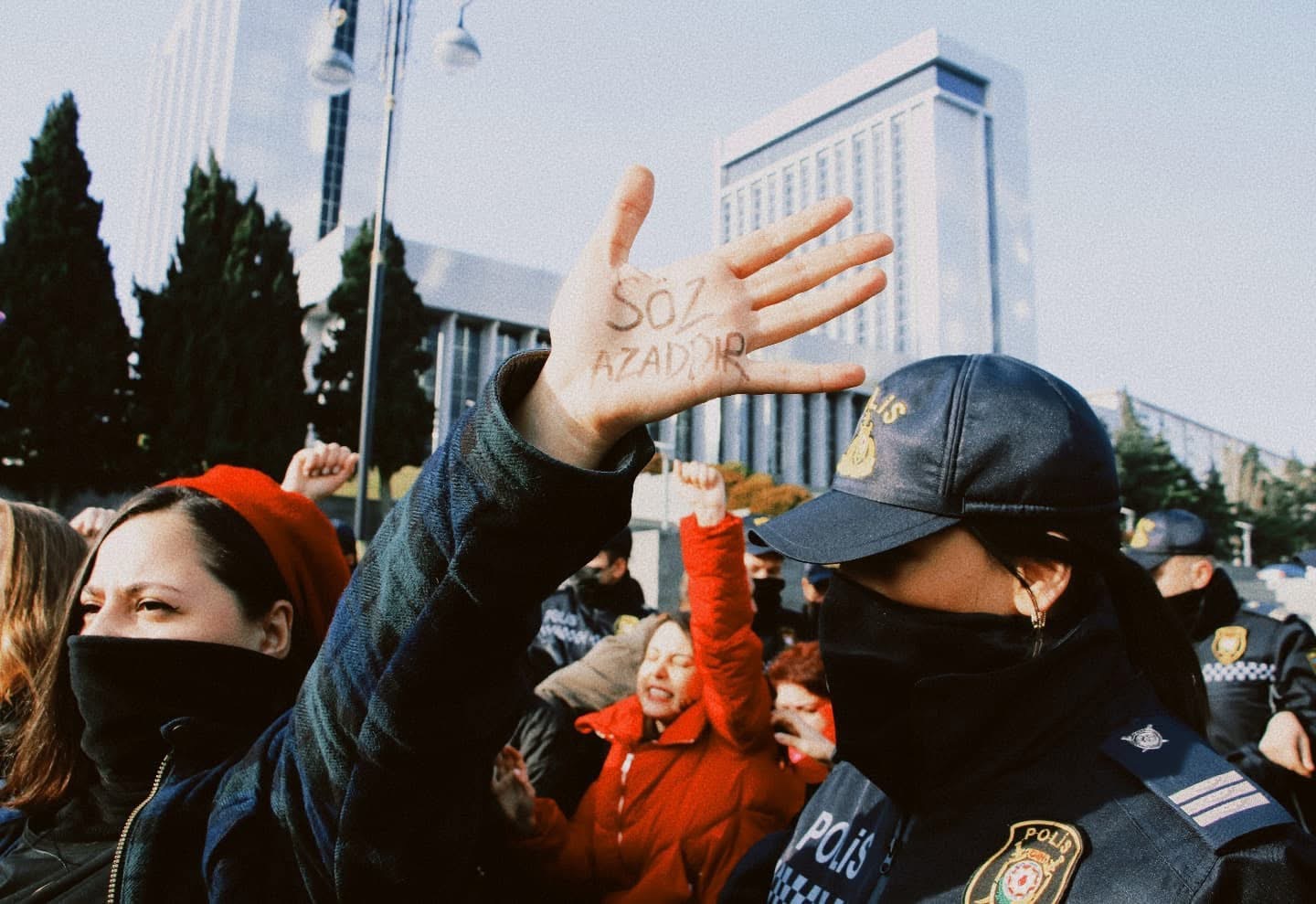
Top photo: “Freedom of expression” Photograph courtesy of imprisoned Azerbaijani journalist Ulviyya Ali.

