


Alongside partners in the Network of Human Rights Houses and beyond, HRHF continued to highlight the repressive strategies employed by authoritarian and authoritarian-leaning states across the wider European region. We are working to strengthen international norms to reflect the growing use of “foreign agents” legislation and other repression to target HRDs, election monitors and journalists. UN member states must reflect these trends in the standards and mechanisms adopted by the Human Rights Council.
Dave Elseroad, Head of Advocacy
Occupied Crimea is a “prison” for its residents
On 3 July, HRHF delivered a statement at the Council, citing its partner Crimean Human Rights Group, which assesses Russian-occupied Crimea as a “prison” for its residents following over a decade of repression and a near-total collapse of civic space. HRHF highlighted and called for action on forced conscription and indoctrination of children, and property confiscation. HRHF also raised continued pressure on civil society on the peninsula with human rights lawyers, especially Crimean Tatars, facing searches, disbarment, and repression. HRHF cited at least 47 new cases of pressure against journalists documented by partner ZMINA. Of those remaining 17 political prisoners, some are in need of urgent medical care, including Iryna Danylovych, Remzi Bekirov, Amet Suleimanov, and Tymur Ibrahimov.
Belarus must release all political prisoners and end crackdown on civil society
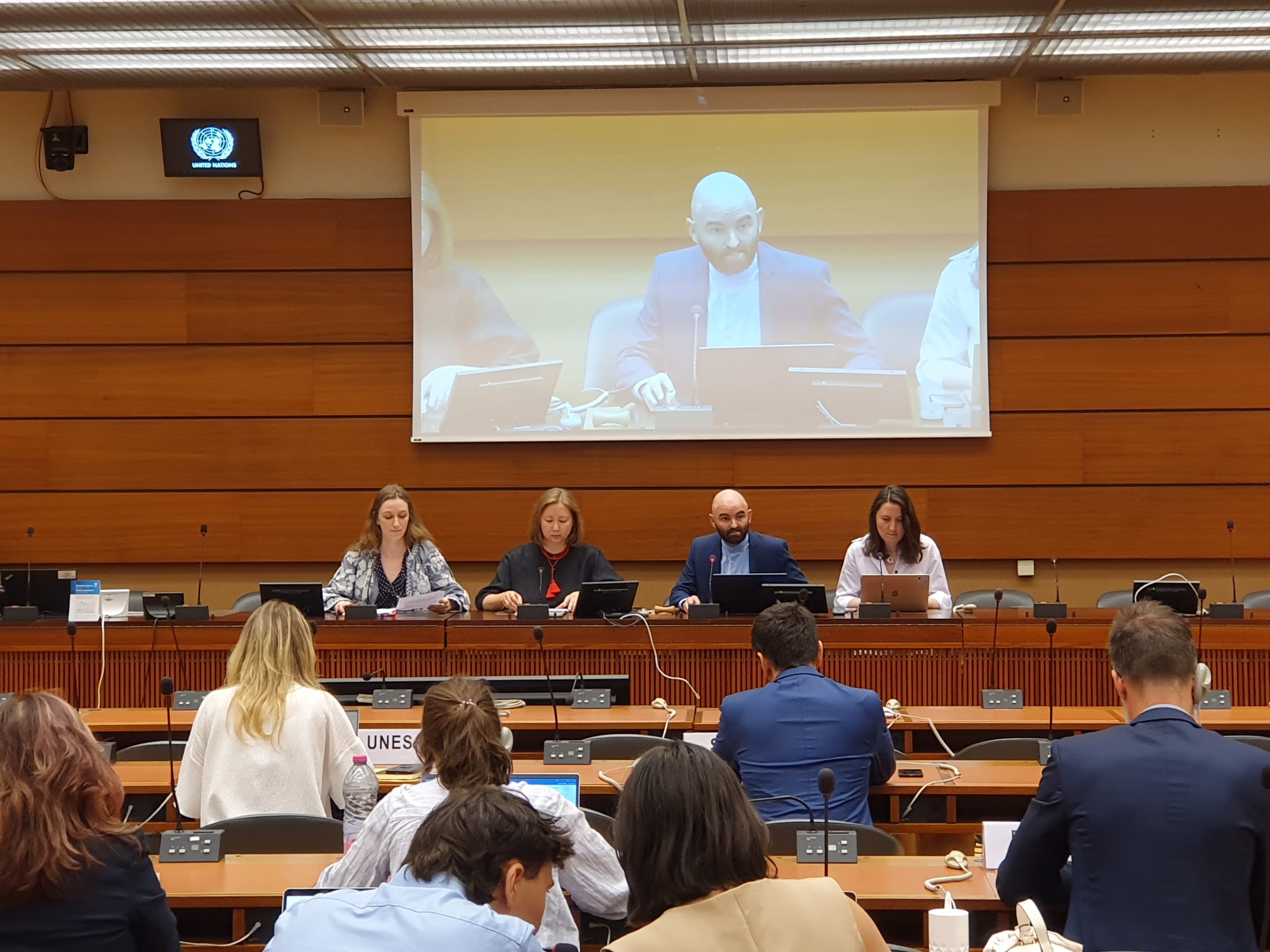
During a dialogue with the Special Rapporteur on the human rights situation in Belarus on 26 July, HRHF urged Belarus to step out of what the Special Rapporteur calls the “shadow of repression” by taking the following action:
- End incommunicado detention and ill-treatment;
- Restore the legal status of liquidated NGOs and allow their work;
- Repeal restrictive and repressive laws;
- And engage with the Council’s Belarus mechanisms.
HRHF also welcomes the limited political prisoner releases of mid-July, but urged Belarus to unconditionally release the remaining 1000+ political prisoners behind bars, including Viasna’s Nobel-laureate Ales Bialiatski, and his colleagues Valiantsin Stefanovich, Uladzimir Labkovich and Marfa Rabkova.
The continued imprisonment of Anar Mammadli illustrates the personal cost of defending voter’s rights
In a statement delivered during an interactive dialogue with the Special Rapporteur on Freedom of Expression and Opinion, HRHF highlighted rising repression of election monitors and journalists in connection with elections. HRHF called for clear benchmarks to hold states accountable during election cycles. HRHF cited SLAPPs against independent journalists and election monitors in Azerbaijan, Georgia and Serbia, and the use of broad “national security”-related legislation to target critical voices.
HRHF once again raised the case of imprisoned Azerbaijani human rights defender Anar Mammadli, behind bars in part for his election monitoring and reporting, and called once more for his immediate release.
Addressing the deteriorating situation for human rights in Georgia
HRHF used an interactive dialogue with the Special Rapporteur on the Freedoms of Assembly and Association, HRHF, to highlight how Georgia’s new “foreign agent” law threatens free association in the country by exposing NGOs to punitive fines, asset freezes and suspension, and now threatens criminal liability for non-compliance. HRHF also reported the politically-motivated administrative fines, totalling more than EUR 1,200, levied on Baia Pataria, head of Union Sapari and member of Human Rights House Tbilisi, for insulting a Georgian Dream Member of Parliament and in violation of the freedom of expression and opinion. HRHF called on Georgia to repeal the foreign agents law, as well as guarantee peaceful assembly, halt arbitrary arrests, and also asked how Georgian civil society can be supported.
Bosnia and Herzegovina should protect human rights defenders and guarantee freedoms
Alongside Human Rights House Banja Luka, HRHF echoed recommendations to Bosnia and Herzegovina in the context of their Universal Periodic Review (UPR), drawing on recommendations the state has accepted:
- Guarantee a safe and enabling environment for all human-rights defenders
- Align all legislation on freedom of association, expression and peaceful assembly with international standards
- Resource and strengthen national human-rights institutions
All HRC58 statements and events
- 4 July: Human rights in Russian-occupied Crimea
- 3 July: Bosnia and Herzegovina should protect human rights defenders and guarantee freedoms
- 27 June: Belarus must release all political prisoners and end crackdown on civil society
- 20 June: Rising repression of election monitors and journalists in the wider European region
- 20 June: Georgia should repeal “foreign agent” law, halt arbitrary arrests, and guarantee peaceful assembly
Thanks to donors
Human Rights House Foundation’s work would not be possible without the generous support that it receives from its donors. HRHF thanks the Norwegian Ministry of Foreign Affairs for supporting its advocacy work, including at the UN Human Rights Council.

 raised the situation for political prisoners in Azerbaijan, Belarus, and Russian-occupied Crimea, including jailed colleagues from the Network of Human Rights Houses, reiterating calls for their release. HRHF worked alongside Network partners calling for action on the repressive strategies of authorities in Georgia, Serbia, and Bosnia and Herzegovina, to attack civic space and fundamental freedoms, as well as advocating for strong resolutions on civic space, safety of journalists, the freedoms of assembly and association, and on Ukraine.&redirect_uri=http%3A%2F%2Fwww.facebook.com%2F)